



Focus on the PhD research of Marion Allaoua, research ccientist at Phodé
At Phodé, we believe that the convergence of academic research and industrial innovation is the key to transforming the potential of plant-based compounds into concrete solutions for health and well-being.
The doctoral research conducted by Marion Allaoua, former CIFRE PhD candidate within the company and now a research scientist at Phodé, perfectly illustrates this dynamic.
A PhD dedicated to plant extracts and their physiological impact
Under the joint supervision of Dr. Michel Treilhou and Dr. Elsa Bonnafé, professors at the Institut Universitaire Champollion d’Albi, and the Phodé R&D team, Marion Allaoua’s thesis focused on investigating the antibacterial efficacy of a plant extract against Campylobacter jejuni and the impact of this active compound on the caecal microbiota of chickens.
Campylobacter: A major public health concern
Campylobacter jejuni is the zoonotic bacterium most frequently responsible for human illness, primarily transmitted through the consumption of contaminated poultry meat (EFSA, 2024).
In animal health, it represents an equally significant challenge, as it disrupts digestive balance, contributes to performance losses, and serves as a zoonotic reservoir (MBio, 2014).
Controlling Campylobacter thus represents a dual objective:
- Health-related, to reduce human infection cases;
- Zootechnical, to improve animal health and welfare.
Given the rise of antimicrobial resistance, exploring plant-based alternatives has emerged as a promising avenue.
Carvacrol: A plant-derived compound with strong potential
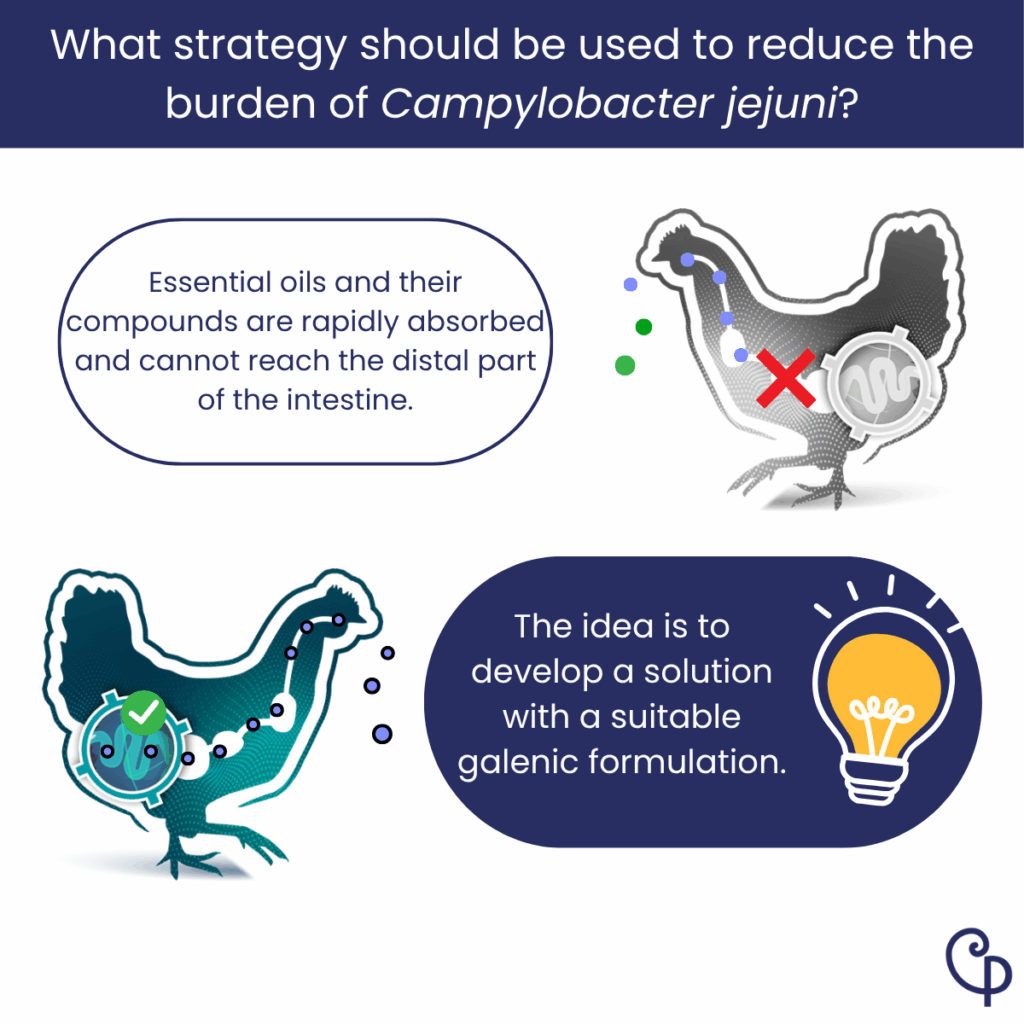
In this study, numerous plant-derived molecules were first screened in vitro for their activity against C. jejuni.
Ultimately, carvacrol, the main active component of oregano essential oil, was selected for its in vitro efficacy against this bacterium and for its well-documented broad-spectrum antimicrobial properties (JFS, 2014; Front. Microbiol., 2017).
The Challenge: Protecting and enhancing a fragile molecule
Although carvacrol shows promising potential, its direct use faces several limitations:
- Without protection, it is rapidly absorbed into systemic circulation (even before reaching the stomach; JSFA, 2008);
- Its antibacterial effect requires direct contact with the target bacterium.
These issues are critical because, in chickens, Campylobacter primarily colonizes the distal intestinal tract, in two pouches called caeca. Therefore, the active molecule must reach the caeca to demonstrate in vivo antibacterial efficacy.
The key role of galenic formulation in carvacrol efficacy
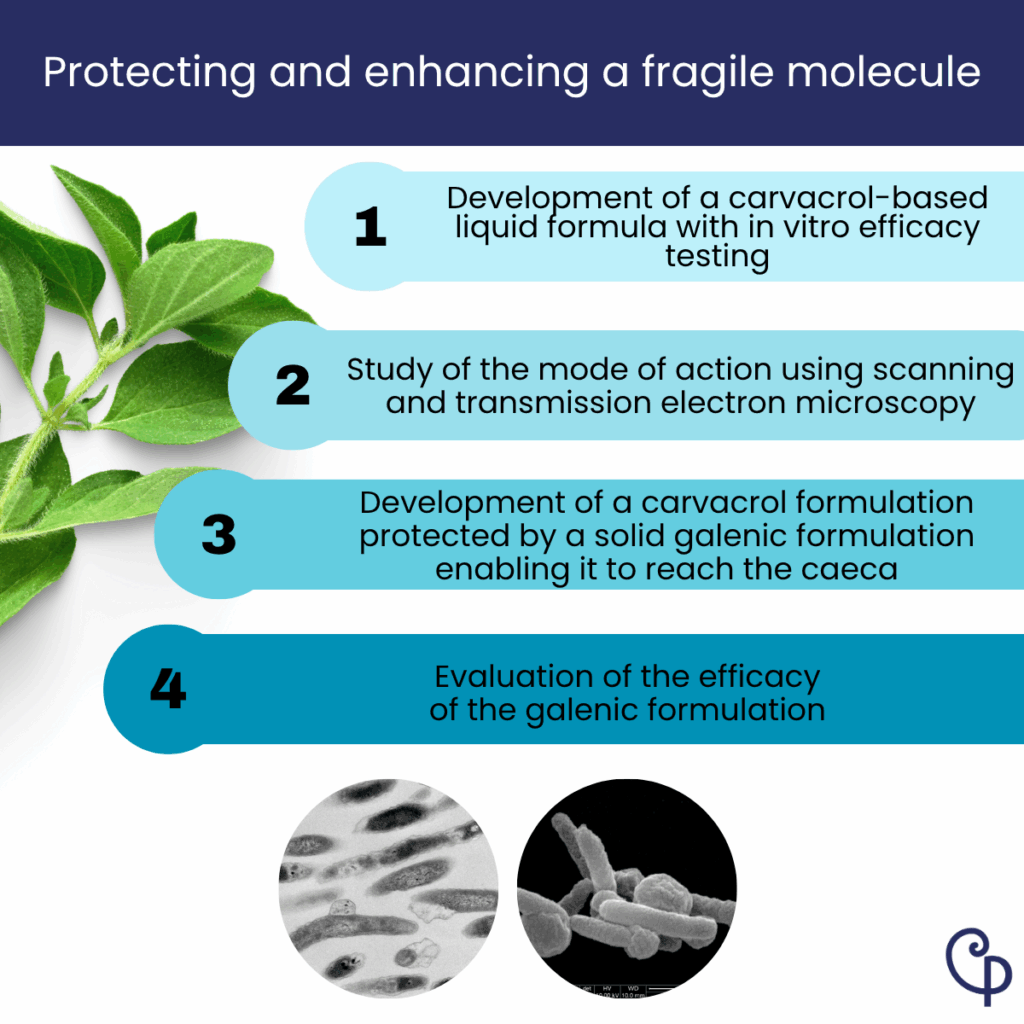
Phodé’s teams developed innovative formulations to protect carvacrol, control its release, and optimize its activity against specific pathogens such as Campylobacter.
Step 1:
A liquid formulation based on carvacrol was developed, and its in vitro antibacterial efficacy was compared to that of unformulated carvacrol. The liquid formulation showed superior in vitro activity.
Step 2:
The mode of action was explored using scanning and transmission electron microscopy. For both formulated and unformulated carvacrol, observations revealed separation between the plasma membrane and the outer membrane, followed by cytoplasmic leakage into the intermembrane space, ultimately leading to membrane rupture and bacterial death.
Step 3:
A solid galenic form of carvacrol was developed to protect the molecule and enable its targeted delivery to the caeca.
A pharmacokinetic study was conducted in post-gavage chickens to track carvacrol’s distribution along the digestive tract and in the bloodstream. This novel formulation significantly limited systemic absorption and concentrated carvacrol in the caeca and large intestine.
Step 4:
The efficacy of the protected galenic form was evaluated at different doses in chickens experimentally infected with a known amount of C. jejuni. After 35 days, chickens receiving the lowest doses displayed a significantly reduced caecal C. jejuni load compared to control groups.
Additionally, inoculated chickens treated with the carvacrol-based formulation exhibited increased microbial diversity and notable modulation of their caecal microbiota composition.
An effective collaborative scientific approach
Marion Allaoua’s work highlights the strength of Phodé’s research model, combining:
- A detailed understanding of physiological mechanisms, particularly the interactions between the microbiota and digestive health, supported by the academic expertise of microbiologists and molecular biologists, including Marion herself;
- Innovative galenic formulation, transforming a fragile plant-derived compound into a functional solution through Phodé’s R&D expertise;
- Targeted application, here focused on Campylobacter, addressing both animal and human health challenges.