Home » How brain activation induced by a sensory ingredient derived from Citrus sinensis paves the way for improved stress management
How brain activation induced by a sensory ingredient derived from Citrus sinensis paves the way for improved stress management
Chronic psychosocial stress represents a major challenge across many contexts, from livestock production—where it affects animal welfare and zootechnical performance—to human health. In response to this reality, industry stakeholders are seeking natural and effective solutions acting directly on the neurological mechanisms underlying stress.
Recent work carried out by the Phodé Research team in collaboration with INRAE has confirmed the effectiveness of an approach based on positive neuro-sensoriality, using a specific ingredient derived from Citrus sinensis extract. This sensory ingredient has been shown to modulate the brain’s response to stress in mammals by acting on fundamental biological pathways.
The aromatic compounds of citrus fruits help to maintain serotonergic receptor activity in the brain by acting through the olfactory and retronasal pathways, thereby contributing to modulating stress perception and supporting a natural return to homeostasis.
A multidisciplinary scientific approach
The effectiveness of the sensory ingredient is not based on simple observation, but on a rigorous three-tier scientific validation process, ranging from behavioural assessments to the analysis of gene expression within the central nervous system.
Behavioural evidence: anxiolytic-like effects in mice
Preliminary work by Coutens et al. (2020) first established the ingredient’s impact on behaviour. The sensory ingredient was tested on 132 mice subjected to pharmacologically induced stress (corticosterone administration).
One week of oral administration of the sensory ingredient demonstrated effects consistent with an anxiolytic-like action. Assessments conducted through a battery of standardised tests (including the open field test, the elevated plus maze, the novelty-suppressed feeding test for anxiety, and the tail suspension and forced swim tests for behavioural despair) showed improved behavioural outcomes. Additional findings from this study already suggested a functional interaction between the olfactory and serotonergic systems.
Coutens, B., Rekik, K., Harster, A., Etienne, P., Noirot, V., Frances, B., Guiard, B. P., 2020. A citrus-based sensory functional food ingredient induces antidepressant-like effects: possible involvement of an interplay between the olfactory and the serotonergic systems. Neuroscience 451, 149–163. https://doi.org/10.1016/j.neuroscience.2020.09.040
Brain evidence: modulation of alertness in pigs
To validate the direct impact on brain activity, a study was conducted by Menneson et al. (2020) on 20 growing female pigs subjected to a chronic psychosocial stress model (social isolation and an unpredictable environment).
Functional Magnetic Resonance Imaging (fMRI) was used to observe brain responses during an acute pharmacological stress challenge. Regular exposure to the sensory ingredient led to modulation of brain regions associated with arousal, perception, and vigilance. This modulation of brain activity in response to acute stress indicates improved stress management in animals receiving the supplementation.
Menneson, S., Serrand, Y., Janvier, R., Noirot, V., Etienne, P., Coquery, N., 2020. Regular exposure to a Citrus-based sensory functional food ingredient alleviates the BOLD brain responses to acute pharmacological stress in a pig model of psychosocial chronic stress. PLoS ONE 15, e0243893. https://doi.org/10.1371/journal.pone.0243893
Molecular evidence: activation of the serotonin receptor (5-HT1AR) in the hippocampus
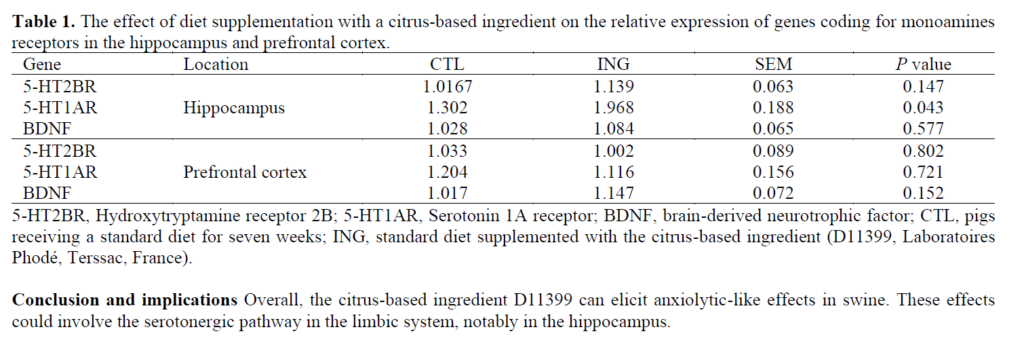
To identify the precise mechanism of action, the study focused on monoamine receptor gene expression in 24 pigs subjected to the same chronic stress model for seven weeks.
Post-mortem quantitative PCR (qPCR) analyses targeted central nervous system tissues, particularly the hippocampus (involved in emotional regulation) and the prefrontal cortex (cognitive control). The study measured the expression of 5-HT1AR, 5-HT2BR and BDNF genes.
The most significant finding was a marked increase in the expression of the gene encoding the 5-HT1A receptor (Serotonin 1A receptor) in the hippocampus of pigs receiving the sensory ingredient (ING) compared with control animals (CTL) (Table 1; P < 0.05).
This body of work demonstrates that olfactory stimulation can be used to positively and directly modulate the brain’s response to stress, confirming the close links between the olfactory and neurochemical systems. A pioneer in the science of olfaction, Phodé reinforces its expertise in sensory actives for stress management and provides solutions with proven efficacy.
For industry stakeholders
Innovative Strategy: This approach validates the use of natural olfactory stimulation as a direct lever for improving emotional homeostasis.
Translational relevance: Since the pig is a physiologically relevant model and the receptor activated (5-HT1AR) is universally involved in anxiety regulation, the sensory ingredient and its mode of action open up potential applications not only for enhancing animal welfare and the sustainability of livestock systems, but also for developing functional nutritional solutions aimed at reducing psychosocial stress in other contexts, including humans.
Pour offrir les meilleures expériences, nous utilisons des technologies telles que les cookies pour stocker et/ou accéder aux informations des appareils. Le fait de consentir à ces technologies nous permettra de traiter des données telles que le comportement de navigation ou les ID uniques sur ce site. Le fait de ne pas consentir ou de retirer son consentement peut avoir un effet négatif sur certaines caractéristiques et fonctions.
Fonctionnel
Always active
L’accès ou le stockage technique est strictement nécessaire dans la finalité d’intérêt légitime de permettre l’utilisation d’un service spécifique explicitement demandé par l’abonné ou l’utilisateur, ou dans le seul but d’effectuer la transmission d’une communication sur un réseau de communications électroniques.
Préférences
L’accès ou le stockage technique est nécessaire dans la finalité d’intérêt légitime de stocker des préférences qui ne sont pas demandées par l’abonné ou l’internaute.
Statistiques
Le stockage ou l’accès technique qui est utilisé exclusivement à des fins statistiques.Le stockage ou l’accès technique qui est utilisé exclusivement dans des finalités statistiques anonymes. En l’absence d’une assignation à comparaître, d’une conformité volontaire de la part de votre fournisseur d’accès à internet ou d’enregistrements supplémentaires provenant d’une tierce partie, les informations stockées ou extraites à cette seule fin ne peuvent généralement pas être utilisées pour vous identifier.
Marketing
L’accès ou le stockage technique est nécessaire pour créer des profils d’internautes afin d’envoyer des publicités, ou pour suivre l’utilisateur sur un site web ou sur plusieurs sites web ayant des finalités marketing similaires.